Why lithium for a sailboat — depth of discharge, weight, alternator load
Three reasons cruisers swap AGM for LiFePO4, in order of how often you'll notice each one.
Depth of discharge — the headline number
An AGM battery rated for 200Ah is happy down to about 50% state of charge before cycle life craters. So your 200Ah AGM bank gives you 100Ah of usable energy. A LiFePO4 battery of the same nameplate capacity is happy to 80–90% DoD, every cycle, for thousands of cycles. Your 200Ah lithium bank gives you 180Ah of usable energy. You roughly doubled your useful capacity without adding battery boxes or weight.
Weight — the second thing you notice
A 100Ah Group 31 AGM is around 64 lb. A 100Ah Battle Born or comparable drop-in LiFePO4 is 31 lb. On a typical cruising sailboat carrying three or four house batteries, you're removing 130–200 lb of dead weight from amidships. That weight comes back as waterline (less drag), fuel range, and one fewer wrenched back when you eventually replace a cell.
Charge acceptance — the one that changes how you cruise
An AGM tapers its charge acceptance as voltage rises. At 80% state of charge it might accept 20A; at 95% it accepts 5A. Bulk-charging an AGM bank to full from 50% takes hours. A lithium battery says yes to whatever you throw at it until the BMS slams the door at about 99% SoC. You can put 100A into a 100Ah Battle Born and it will absorb every amp. Practical impact: a 60-minute engine run at anchor charges your house bank further than a 4-hour engine run with AGM. Or: your solar array actually gets to deliver its rated output instead of being throttled by the battery's reluctance to accept the current.
The fourth reason — cycle life — is real but is the slowest to show up. 3,000–5,000 cycles to 80% capacity versus 300–500 for lead means your lithium bank will outlast three or four AGM replacements at the same cost over the life of the boat. Most cruisers don't think about that until year four or five.
Drop-in vs DIY — what you trade for half the cost
The decision people agonize over. Drop-in is Battle Born, Renogy, Dakota Lithium, ePropulsion E-Series — a fully sealed Group 27 or Group 31 case with internal BMS, ready to swap into the existing battery box. DIY is four prismatic cells (EVE LF280K, CATL 304Ah), an external BMS (Overkill Solar's Pathfinder, or a JBD smart BMS), busbars, and a box you build.
Drop-in: $1,900–$3,000 for 200Ah, 90 minutes of install
The math is straightforward. You pull out the old AGM, drop in the new Battle Borns, reconnect the leads, and you have a lithium house bank. The internal BMS handles balancing, low-voltage cutoff, high-voltage cutoff, over-current protection, and (on heated models) cold-charge protection. Battle Born's 200A BMS spec means you can sustain 200A continuous load and ~400A surge — enough for most cruising loads but a bottleneck for high-output alternators and large inverters running at full tilt.
DIY: $1,200–$1,500 for 280Ah, a long weekend of work
Four EVE LF280K cells run about $700–$900 shipped from a reputable supplier. Overkill Solar's Pathfinder BMS is $230 (a JBD 4S 200A smart BMS bought direct from JBD is about $125). Busbars, marine-grade enclosure, fuses, and balance wires add $200. You then have to top-balance the cells (parallel them at 3.65V for 12–24 hours so all four start at the same SoC), wire them in 4S configuration, attach the BMS balance leads, configure the BMS over Bluetooth, build a vented enclosure that meets ABYC requirements, and commission. Total cost ~$1,400, total time 8–16 hours over a weekend if it's your first build.
What you trade for the savings: time, the entire responsibility for the build, and the fact that if something goes wrong at 2 AM offshore there's no manufacturer support number to call. What you gain: full visibility into and control over the BMS settings (balancing thresholds, cutoff voltages, temperature limits), the ability to swap individual cells if one fails, and the satisfaction of a build that's documentably tuned to your boat.
Most cruisers we know who run lithium chose drop-in for the first install and migrated to DIY later, after they understood how the system actually behaved. If this is your first lithium upgrade, drop-in is the lower-risk path. DIY is the right pick when you've lived with a drop-in for a year and decided you want more capacity, more control, or both.
Three banks compared, in detail
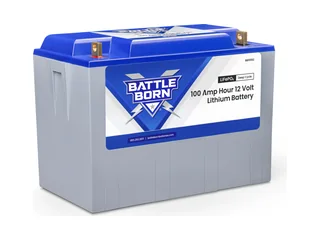
Battle Born BB10012 pair — the reference drop-in
Battle Born is the brand most cruisers reach for and most marine techs are familiar with. Made in Reno, NV by Dragonfly Energy; 200A continuous, 500A surge for 30 seconds; internal BMS handles all the safety functions; available with or without an internal heater (the heated version is worth the $100 premium if you ever charge in temperatures below 32°F). The 10-year warranty is genuine — Dragonfly has been around long enough to honor multi-year warranty claims and their support is genuinely useful. The pair gives you 200Ah of nameplate capacity, ~180Ah usable, dropping into the exact footprint where two Group 31 AGMs lived. Reconnect the leads, verify charge profile on your existing charger (set to LiFePO4 if available, custom profile of 14.4V absorb / 13.4V float if not), and the install is done. Wire two in series instead of parallel for 24V systems.
Strengths
- Group 31 footprint — same battery box, same cable runs
- Internal BMS — no external wiring or programming
- 200A continuous handles typical cruiser loads cleanly
- 10-year warranty, US support, mature product
- Heated option for cold-climate installs
Trade-offs
- $950/unit is roughly 2× the per-Ah cost of DIY
- 200A BMS bottlenecks 250A+ alternators or 3kW inverters at full load
- No visibility into individual cell behavior
- Internal BMS means battery replacement when BMS fails (rare but real)
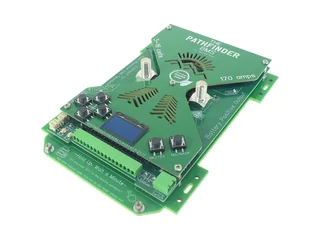
DIY: EVE 280Ah + Overkill Solar Pathfinder BMS — half the cost
DIY LiFePO4 is the path for cruisers who enjoy the build and want maximum capacity for the dollar. Four EVE LF280K (or comparable CATL 304Ah) prismatic cells in 4-series configuration give you 280–304Ah of 12V house bank. For years the canonical hobbyist BMS was a JBD board sold and supported by Overkill Solar; Overkill has since stopped selling JBD units (its remaining stock is listed as end-of-life) and replaced them with its own Pathfinder BMS — $229.99, assembled and supported in Naples, Florida, rated for 170A continuous and 3–16 cells, with a built-in OLED display, Bluetooth and Wi-Fi, over-the-air firmware updates, MQTT for Home Assistant, and full visibility into individual cell voltages via the Overkill Solar app. If you'd rather stay with JBD, JBD's own store still lists 4S 12V smart BMS boards up to 200A (about $125) — you just lose Overkill's US-based support. The build involves: top-balancing the four cells in parallel at 3.65V (12–24 hours with a regulated bench supply), wiring them in 4S with quality copper busbars (not bus bar kits from random Amazon sellers — get the OS-recommended ones), attaching the BMS balance leads in the correct order, building a vented enclosure that meets ABYC requirements (Class 8 battery installation standards), and adding a Class T fuse close to the positive terminal. Document the build, photograph the busbars, and commission with a load test. The reward: 280Ah for the cost of 200Ah drop-in, full control over the BMS, and a system you can repair cell-by-cell instead of replacing wholesale.
Strengths
- Roughly half the per-Ah cost of Battle Born
- Full visibility into individual cell behavior via Bluetooth
- Configurable BMS thresholds for your charge profile
- Repairable — swap individual cells, replace BMS independently
- Active community + documented build patterns
Trade-offs
- 8–16 hours of build time for a first install
- You own all safety responsibility — fuse sizing, enclosure ventilation, charge profile
- No manufacturer warranty on cells if you source from grey-market suppliers
- Top-balancing requires a regulated DC power supply
- Insurance underwriters may want documentation
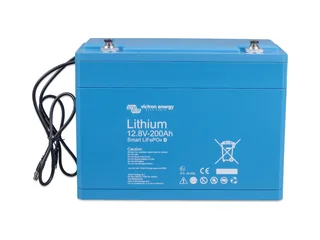
Victron LiFePO4 200Ah + Cerbo GX — the yacht-grade install
The Victron stack is what you build when you want the cleanest possible integrated system — everything talks to everything, everything is monitored, everything is remotely manageable through the VRM portal. The 200Ah Smart LiFePO4 plugs into the Lynx Distributor (a busbar-with-monitoring device) which connects to a Cerbo GX (a Raspberry Pi running Victron's Venus OS). The Cerbo talks to your Victron MPPT solar controllers, MultiPlus inverter/charger, Smart BMV battery monitor, and Smart Shunt — all over Victron's Bluetooth and VE.Direct protocols. From your phone (or any browser, from anywhere in the world if the boat has internet) you see live state of charge, instantaneous power flow from solar/shore/battery/load, and historical graphs of the past year. The downside is real: you're committing to the Victron ecosystem for solar charge controllers, inverter, and monitoring, which means $4,000–$8,000 in additional Victron hardware for the full integrated system. The upside is also real: when something goes wrong at 3 AM, you check the VRM portal from your phone and you know exactly what's wrong before you climb into the engine room.
Strengths
- Cerbo GX is the cleanest system brain on the market
- VRM portal — remote monitoring and control from anywhere
- Smart Lithium battery integrates natively with Victron MPPT and inverter
- Mature, well-documented ecosystem with strong dealer support
- Lynx Distributor cleans up the wiring around the bank
Trade-offs
- The premium is the ecosystem, not the battery — Cerbo + Lynx add ~$2,000+ on top
- Full integration requires Victron MPPT, inverter, and monitoring (~$4,000+)
- External BMS means more boxes to mount and wire
- Remote monitoring assumes the boat has reliable internet
BMS choices — internal vs external, what to look for
The Battery Management System is the brain of any lithium install. It monitors individual cell voltages, balances them during charge, cuts off the bank at low or high voltage, limits charge and discharge current, and protects against over-temperature. Two design choices to understand.
Internal BMS (Battle Born, Renogy, Dakota)
The BMS lives inside the battery case and is invisible to the installer. Pros: zero wiring complexity, factory-tuned thresholds, no installer error possible. Cons: zero visibility into cell behavior (you can't see which cell is drifting), no configuration, when the BMS fails the battery is bricked. Internal BMS is the right choice for cruisers who want a battery, not a project.
External BMS (Overkill Solar Pathfinder, JBD, Victron Lynx, REC Active)
The BMS is a separate device wired to balance leads on each cell. Pros: full Bluetooth or NMEA 2000 visibility into every parameter, configurable thresholds, can be replaced independently if it fails. Cons: more wiring, balance leads must be installed in the correct order or you damage the BMS, configuration mistakes can disable the bank. External BMS is the right choice when you want to know what's happening or when you're building DIY.
What to verify on any BMS
- Continuous current rating — must exceed sum of your worst-case loads plus inverter peak (typically 200A is plenty; 300A if you have a 3000W inverter)
- Low-voltage cutoff — should disconnect loads at 11.0–11.5V to protect the cells
- High-voltage cutoff — should disconnect charging at 14.6V to prevent over-charging
- Temperature protection — low-temp charge cutoff at 32°F to prevent lithium plating
- Communication — Bluetooth for DIY, NMEA 2000 or VE.Direct for integration with Signal K or Victron VRM
Charging changes — alternator regulator, MPPT, shore-power
This is the section that catches people. The batteries are the easy part. The system you have to charge them with is where the work and expense live.
Alternator regulator — mandatory for a sailboat with engine charging
Your stock alternator regulator was designed for lead-acid batteries that taper their acceptance as voltage rises. A lithium bank does not taper — it says yes to whatever the alternator can give it, right up until the BMS slams the door at 14.6V. Without a programmable regulator, your alternator will run flat-out for hours, overheat, and die. Three options:
- Balmar MC-614 / MC-624 (around $500) — the standard external regulator. Programmable charge profile, temperature compensation via remote sensors, alternator temperature limiting. The cruiser default.
- Wakespeed WS500 (around $650) — newer, with NMEA 2000 integration and full integration with Victron systems via VE.Can. The yacht-grade pick.
- Sterling Alternator to Battery Charger (around $400) — sits between alternator and battery, presenting the alternator with a fake lead-acid load. Simplest install, no alternator-side wiring.
Solar charge controller — already lithium-aware if it's an MPPT
Any modern MPPT solar controller (Victron SmartSolar, Renogy Rover, EPEver) has a LiFePO4 charge profile in firmware. Set it during install — 14.4V absorb, 13.4V float, no equalization — and the controller does the right thing. If your solar controller is a 1990s-era PWM unit, replace it. The MPPT upgrade pays for itself in solar harvest alone within a year.
Shore-power charger — same firmware story
Modern Victron, ProMariner, Mastervolt, and Sterling shore-power chargers have a LiFePO4 mode. Switch it on. Older chargers without a lithium mode can usually be configured to a "custom" profile of 14.4V absorb / 13.4V float / no equalization, which works fine for occasional shore-power use. Permanent dock dwellers should buy a lithium-native charger.
Wiring & safety — fuses, busbars, isolation
Lithium banks can deliver enormous fault currents. Battle Born specs 200A continuous and 500A surge; a DIY 280Ah bank can deliver 1,500A+ into a dead short. Wiring for lithium is the same wiring you'd run for any high-current marine install — just done more carefully because the bank cannot tap out the way an old lead-acid bank would.
Class T fuses on every positive terminal
A Class T fuse is the only fuse rated to interrupt the AIC (Amps Interrupting Capability) of a lithium fault — typically 20,000A. ANL fuses, MEGA fuses, and resettable breakers are not adequate. Buy a 200A or 250A Class T fuse and install it within 7 inches of the positive battery terminal. This is the non-negotiable safety component.
Busbars and cable
Use marine-grade tinned copper cable, sized for your maximum continuous current with a 3% voltage drop margin (typically 2/0 AWG for 200A runs under 10 feet). Busbars from Blue Sea Systems are the standard for marine installs; do not improvise with hardware-store copper. Crimp every connection with a proper hex crimper and heat-shrink each terminal — soldered marine connections are explicitly prohibited by ABYC because of vibration fatigue.
Battery enclosure
ABYC E-10 requires the battery enclosure to be vented (because lithium can vent flammable electrolyte under fault conditions, even if rarely), secured against shifting, insulated from positive terminals contacting metal, and accessible for inspection. For DIY builds the enclosure must be sized to handle the BMS, balance leads, fuse, and a removable cover. A pre-built enclosure from Smartbox or similar is around $200 and saves the design work.
Isolation from the starter battery
The starter battery should remain lead-acid (lithium does not love the high amp surge of a starter motor, and the engine charging path is different). Isolate the two systems with a DC-DC charger (Victron Orion-Tr Smart 30A or 50A) that lets the alternator charge the lithium house bank through the DC-DC while keeping the start battery on the alternator's direct output. Simpler installs sometimes use a battery isolator, but a DC-DC charger gives you a properly regulated charge profile to the lithium side.
Install & commissioning sequence
The right order of operations on a typical sailboat upgrade.
- Pull old batteries. Measure the existing AGM bank's state of charge, then disconnect the negative, then positive, then remove them. Recycle responsibly.
- Upgrade solar MPPT charge controller if needed. Set the LiFePO4 charge profile in the new controller.
- Upgrade shore-power charger or set the lithium profile in your existing one.
- Install alternator regulator. Wire the Balmar or Wakespeed to the alternator field, temperature sensor on the alternator case, and battery-bank temperature sensor at the bank.
- Install DC-DC charger between the alternator and the lithium bank, with the start battery on the alternator's direct output.
- Install Class T fuse within 7" of the lithium positive terminal.
- Install the lithium batteries. For DIY: build the enclosure, top-balance cells, wire 4S, configure BMS, install in the enclosure, test the BMS at low current before connecting to ship loads.
- Connect to ship's wiring. Negative first, then positive through the Class T fuse.
- Commission. Charge to 100% on shore power. Verify BMS is balancing. Run a discharge test at moderate load (~50A) to verify cutoff behavior. Verify alternator regulator brings the bank up cleanly during a 30-minute engine run.
- Update battery monitor. Set new capacity (e.g., 280Ah), new charged-voltage threshold (13.6V for LiFePO4), new full-discharge threshold (11.5V).
Total install time for a competent owner-installer: one long day for drop-in, two days for DIY. Add another day if you're also upgrading solar or shore-power chargers as part of the project. See our solar power for smart boats guide for the solar side and the battery monitor guide for monitoring options.
Frequently asked questions
Why upgrade a sailboat house bank from lead-acid to lithium?
Three real reasons. First, depth of discharge: LiFePO4 happily goes to 80–90% DoD versus 50% for AGM, so 200Ah of lithium gives you the usable energy of 320–400Ah of lead. Second, weight: a 100Ah Battle Born is around 31 lb versus 64 lb for an equivalent AGM — a meaningful waterline saving when you upgrade three or four batteries. Third, charge acceptance: lithium swallows whatever your alternator and solar can throw at it, which means shorter engine charging times at anchor and full advantage from your solar array. Cycle life is the bonus on top — 3,000–5,000 cycles to 80% versus 300–500 for lead.
What is a drop-in lithium battery and when is it the right pick?
A drop-in LiFePO4 battery (Battle Born, Renogy, Dakota Lithium) is built in a standard Group 27 or Group 31 case with internal BMS, designed to replace a lead-acid battery as a one-for-one swap. The right pick when you want the upgrade without redesigning your electrical system: same battery box, same terminal layout, same charge profile within the limits the BMS allows. Trade-off is cost ($800–$1,000 per 100Ah versus ~$400 for DIY) and a 200A typical BMS current limit that bottlenecks high-output alternators.
Do I need a new alternator regulator for a lithium house bank?
Almost always, yes. Your stock alternator regulator was designed for lead-acid: it tapers charge current as voltage rises, and assumes the battery will resist taking more than ~30A at 90% state of charge. A lithium battery says yes to whatever you give it until the BMS slams the door. Without a programmable regulator (Balmar MC-614, Wakespeed WS500, Sterling alternator-to-battery charger), you risk frying the alternator on long charging runs. Budget $400–$700 for the regulator and 2–3 hours of install.
Can I parallel lithium with my existing lead-acid bank?
No, not safely. Lithium and lead have different charge voltage profiles, different internal resistance, and different acceptance curves. Paralleled, the lithium will absorb all the charge current first, the lead will be chronically undercharged, and you'll kill the lead bank in months. The correct architecture is a fully isolated lithium house bank with the lead bank either retired entirely or kept as a dedicated start battery on its own charging path. A DC-DC charger (Victron Orion-Tr Smart) bridges the two when needed.
Is DIY LiFePO4 cheaper than Battle Born or Renogy drop-ins?
Yes, by roughly half. Four 280Ah EVE or CATL prismatic cells plus a DIY-grade BMS (Overkill Solar's Pathfinder, or a JBD board bought direct) comes to around $1,000–$1,400 for the equivalent of a 280Ah 12V bank. Comparable Battle Born capacity (three 100Ah units) would be $2,400–$3,000. The catch is real work: you build the busbars, top-balance the cells, design the enclosure, wire and configure the BMS, and accept all the responsibility for a system that drop-ins handle internally. DIY is the right pick if you enjoy the build; drop-in is the right pick if you do not.
How much solar do I need to keep a lithium house bank charged at anchor?
Rule of thumb: 1 watt of solar per amp-hour of bank for a typical cruising load. A 200Ah lithium bank wants around 200W of solar minimum, 300–400W is comfortable. The math: average daily draw for a cruising sailboat with refrigeration is 80–120Ah/day; 300W of solar in Florida averages 60–90Ah/day output; the gap is closed by alternator runs while motoring. See our solar power for smart boats guide for the full sizing math.
The short version, by profile
First lithium upgrade, want the lowest-risk path: Battle Born BB10012 pair. ~$1,900, drop-in install, 10-year warranty, made in the US. Budget another $500–$700 for a Balmar or Wakespeed alternator regulator. Total system upgrade ~$2,500–$3,000.
Enjoy the build and want maximum capacity for the dollar: DIY 280Ah using EVE LF280K cells and an Overkill Solar Pathfinder BMS. ~$1,400 for the bank, plus the regulator and a vented enclosure. A long weekend of work, ~40% more usable capacity than the drop-in pair for less money.
Yacht-grade integrated system, you already run Victron: Victron 200Ah Smart LiFePO4 + Cerbo GX + Lynx Distributor. ~$1,500 for the battery, ~$2,000+ for Cerbo + Lynx, full VRM cloud monitoring. The right answer when monitoring and remote visibility matter more than upfront cost.
The general rule: the battery is 40% of the project. Plan for the alternator regulator, solar MPPT, shore-power charger, Class T fuse, and a battery monitor as part of the upgrade, not afterthoughts. The full system runs ~$2,500 (drop-in budget) to ~$8,000 (yacht-grade integrated). Budget for the system, not the batteries.