Why sailboats are different
Most bilge-monitoring guides treat a sailboat like a small powerboat. (If you want broader monitoring — bilge plus battery, intrusion, temperature — see our cellular boat monitoring guide.) It's a different animal in three ways that matter a lot:
Sailboats heel
A beam reach in 15 knots of wind puts the boat at 15–25 degrees of heel. Water sloshes. The bilge that's dry on a sunny afternoon at the dock is a puddle when you're driving hard on a Saturday. A bilge sensor has to distinguish "there's water in the bilge because I'm heeled" from "there's water in the bilge because a seacock failed". Most cheap float switches can't — they trigger every time you tack.
Masts interfere with antennas
A modern mast is an aluminum pole 40–50 feet tall running through the center of the boat. This is, from an RF standpoint, a large metal antenna. Cellular hubs installed in the cabin have to route around it. Wi-Fi signals bounce off it. GPS positioning can be distorted by it. Installation in a sailboat is not the same as installation in a powerboat — antenna placement matters more.
Sailboats often don't have shore power
A powerboat that lives in a slip is plugged into 30A shore power. A sailboat on a mooring in New England, or a trailer-sailor launched for the weekend, has no such thing. Battery-sipping matters — a monitor that draws power around the clock (like a Siren hub) is a non-issue with shore power and a significant load on a 100Ah house bank.
Probe technology: float switches vs. field-effect
The single most important technical decision in a sailboat bilge monitor is what kind of probe senses the water.
Float switches
A mechanical float that rises with water level, closing a switch when it hits a certain height. Cheap ($15–30), simple, and the traditional choice. Three real problems on a sailboat:
- Heel tilts the float — it can trigger on heel alone with no actual bilge water
- Oil, hair, and debris gunk up the mechanism over a season
- They fail silently — the float jams, you never know until it matters
Mirus field-effect probes
Non-contact water detection using capacitive sensing. The probe detects water through the hull or through the probe body — no moving parts, no mechanical failure point. This is the technology in the Johnson Pump Bilge Alert. Key advantages for sailboats:
- A 3-second trigger delay filters out brief splashes
- No contact with water means no corrosion, no gunk buildup
- Reliable for 10+ years with no mechanical degradation
"A float switch on a sailboat is a coin flip between 'alerts every time you tack' and 'jammed and silent.' Field-effect probes exist because someone got tired of that."
If there is one thing you take from this guide, it's this: do not use a mechanical float switch as the alerting sensor on a sailboat. Keep your existing float for pump activation if you want, but add a probe-type sensor for the alerting signal. Of our picks, Siren's Wireless High-Water Sensor uses a water probe rather than a float; ArmIt's BilgeMAX One is float-based, so read the caveat in its section.
Coastal sailor's pick: Siren 3 + wireless high-water sensor
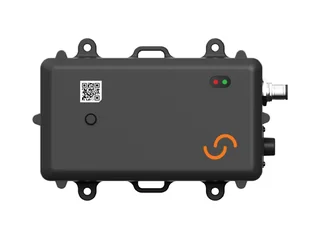
Siren 3 main device + wireless high-water sensor
Why it wins for coastal sailors
- Water probe instead of a float — nothing to tilt or jam
- Wireless sensor (up to 100 ft range) can be placed independently of the hub
- Platform scales — add battery, entry/hatch, bilge-pump and temperature sensors later
- Seasonal plan is a real 33% discount for lay-up boats
- App is genuinely the best in the category
Trade-offs
- Hub draws power around the clock — a real load on battery-only boats
- $225/yr subscription is the category price, still a subscription
- Install takes longer than ArmIt's wire-free sensors (2–3 hrs)
If your sailboat lives in a slip with regular shore power, the Siren 3 with its wireless high-water sensor is the right tool. You get a real platform — one app, one hub, one subscription — that you can grow into. Start with just the high-water sensor. Add a battery-voltage sensor next season. Add an entry (hatch) sensor the season after that. You're building toward comprehensive coverage without buying a new system each time.
The specific advantage for sailboats is Siren's Wireless High-Water Sensor: a water probe on a short tail that you fix at whatever height you choose in the bilge, and that alerts when water rises above it. There is no float to tilt on heel or jam with debris — set the probe above normal sloshing height and it stays quiet until the water is real. And because the sensor is wireless (917 MHz, up to 100 feet), you can put the probe in the deepest part of the bilge while mounting the hub somewhere with better antenna access. Note that Siren also sells a separate Wireless Bilge Sensor, which watches bilge-pump run time and cycles rather than water level — a useful second sensor, but not a high-water alarm.
Trailer-sailor's pick: ArmIt BilgeMAX One
ArmIt BilgeMAX One Monitoring Kit
Why it wins for trailer-sailors
- No boat power required — runs for years on its internal battery
- No hub means no antenna-placement headache around the mast
- Wire-free install, no pairing step
- Lowest up-front and three-year cost of our picks for bilge-only monitoring
- If you only sail weekends, this is the honest amount of monitoring you need
Trade-offs
- Works only where ArmIt's private network reaches — check your location first
- BilgeMAX One is float-based, so placement matters on a heeling boat
- App is weaker than Siren's
- More devices mean a bigger plan: $150/yr covers up to three, $275/yr unlimited
If your sailboat is a trailer-sailor, or sits on a mooring in a field with no shore power, or is a dinghy you launch occasionally — the ArmIt BilgeMAX One is a genuinely better tool than Siren. The architectural choice matters: it has no hub. Each battery-powered MAX device talks directly to ArmIt's own network. That means no shore power requirement, no antenna-placement drama around the mast, no worry about a discharged battery killing the monitor on a three-month layup.
ArmIt no longer runs on a cellular carrier. Its MAX sensors connect over ArmIt's private EarthSmart Maritime Network, which covers specific marinas and waterways rather than whole regions, and ArmIt checks coverage by hand for each location. Confirm your slip, mooring field or storage yard is covered before buying — a trailer-sailor that launches from different ramps may be out of range much of the time. Beyond coverage, ArmIt's Voyager add-on ($199 provisioning plus $149.99/yr) keeps the sensors connected through an onboard connection such as Starlink or roaming carrier networks. For international cruising, look at Yacht Sentinel or Siren instead.
The BilgeMAX One also uses a float switch, which is exactly what we warn about above. Mount the float where ordinary heel sloshing won't lift it (ArmIt suggests placing the float for the water event you care about and the sensor module high and dry), and test it at heel before you rely on it.
International cruiser's pick: Yacht Sentinel YS Pro
Yacht Sentinel YS Pro + bilge sensor
Why it wins for international cruising
- Embedded 3G/4G SIM with published coverage zones spanning more than 100 countries
- Same €20/month in the EU and US zones
- Keeps recording for months when there's no signal, then catches up
- NMEA 2000, J1939 and Modbus data built in — no add-on module
- Very low draw (under 0.3 W) for 24/7 monitoring
- From a maker building connected-boat hardware since 2008
Trade-offs
- No built-in satellite link — offshore it needs the boat's own internet (Wi-Fi or Ethernet, such as Starlink), or it just logs until it's back in range
- Zones outside the EU and US cost €25–€50/month
- Most expensive of our picks up front; priced in euros, excluding VAT
For a sailboat based in Europe, or one that cruises between countries, Yacht Sentinel's YS Pro is the most coverage-transparent monitor we've found. It ships with an embedded SIM, Yacht Sentinel publishes the countries and carriers in each pricing zone, and the EU and US zones cost the same €20 a month. When there's no signal it keeps logging and uploads later. YS Pro replaced the Yacht Sentinel 6 (the company's 2015 wireless-sensor unit), which is no longer sold.
What it doesn't have is a satellite link of its own. YS Pro has no Iridium or other satellite option; offshore, it can only report through the boat's own internet (it accepts Wi-Fi or Ethernet, so a boat with Starlink keeps it online), and otherwise it logs until it's back in cellular range. ArmIt says its Voyager add-on can fall back to satellite when out of terrestrial range but doesn't say which network or what it costs. The other option here is Siren's SirenSat add-on for the Siren 3 Pro (a Globalstar antenna at $259.99 plus $350 a year, on top of the cellular plan), which tracks position and geofences outside cellular range — tracking, not bilge alerts. If you cross oceans without onboard internet, carry a satellite communicator for the passages and let the monitor cover the boat while it's in port.
Installation on sailboats specifically
A few sailboat-specific notes that most monitoring vendors' installation documentation doesn't cover well:
Antenna placement
On a sailboat, the mast is a giant metal obstruction. For a Siren 3 hub with a built-in antenna, install the hub as far from the mast as practical, ideally in the forward or aft cabin rather than directly beneath the mast step. Forum users report ~20dB signal drops from bad placement — enough to turn a marginal coverage area into an unreliable one.
Probe placement
Mount the bilge probe below the water-pump activation level, not at it. You want to be alerted when water is rising enough to reach the pump threshold — not when the pump is already running. A common misconfiguration is to mount the sensor at pump-activation height and then get surprised by alerts arriving simultaneous with pump activity.
Power routing
If you have shore power, wire the monitor to an always-on bus (usually a dedicated battery terminal, not through the main switch). If you're on batteries only, consider installing a small solar panel just for the monitor — a 10W panel is enough to offset the continuous draw of a Siren hub and prevents the monitor from killing the house bank during lay-up.
What we'd skip
Float-switch-only monitors under $50
The cheap Amazon "boat bilge alarm" products that just wire to an existing float switch. They're the worst of both worlds: you keep the float's failure modes, you add a weak cellular-or-SMS module, and the combined reliability is worse than either component alone.
Wi-Fi-only bilge monitors
A Wi-Fi-only monitor depends on your boat having its own Wi-Fi, or being within range of marina Wi-Fi that is typically weak and unreliable. When you're away, the monitor is offline at exactly the moment you need it most.
Apps that require a gateway app running on your phone at the boat
Some cheap systems only alert while your phone is actively running their app with Bluetooth enabled. This is not monitoring. This is a lazy app-to-sensor shortcut that fails the moment your phone isn't aboard.
When we'd update this pick
We'll revisit these picks when:
- Siren ships a true low-power monitoring mode — a "winter lay-up" mode that drops the continuous draw under 10mA would change the calculus for battery-only sailboats substantially
- ArmIt's EarthSmart network reaches enough marinas and mooring fields that coverage stops being the first question — that would strengthen its case against Siren for coastal sailors too
- A mainstream monitor adds satellite bilge alerting (not just position tracking) at a sane price — that would earn a true offshore pick
- Signal K integration arrives from any mainstream commercial vendor
Frequently asked questions
What is the best bilge monitor for a sailboat?
For most coastal sailboats with shore power, the Siren 3 with Siren's Wireless High-Water Sensor is the right tool: a water probe (not a float) that alerts when bilge water rises above the height you set, on a platform you can grow. For trailer-sailors and mooring-field boats with no shore power, the ArmIt BilgeMAX One runs on its own internal battery with no hub, provided ArmIt's private network covers where the boat lives. For boats based in Europe or cruising between countries, Yacht Sentinel's YS Pro has the broadest published cellular coverage. None of them has a built-in satellite link for bilge alerts; YS Pro can use a boat's own Wi-Fi or Ethernet (such as Starlink) instead.
Will a bilge monitor work when my sailboat is heeled?
Only if it uses a Mirus field-effect (non-contact capacitive) probe. Mechanical float switches trigger on heel alone because water sloshes during a beam reach, producing false alerts every tack. Field-effect probes use an 8-second delay to filter sloshing and detect only sustained water rise, which is what you actually want to know about.
Do I need shore power to run a bilge monitor on a sailboat?
Not necessarily. Hub-based systems like the Siren 3 draw power around the clock, which is a real load on a 100Ah house bank during lay-up. Standalone battery-powered sensors like the ArmIt BilgeMAX One run for years on an internal battery with no boat power. If you want a hub-based system on a battery-only boat, install a small 10W solar panel dedicated to the monitor.
Are float switches reliable on sailboats?
Not as alerting sensors. Mechanical float switches on a sailboat fail in three ways: heel tilts the float and triggers false alerts, oil and debris gunk up the mechanism over a season, and they fail silently when the float jams. Keep the float switch for pump activation if you want, but use a Mirus field-effect probe for the alerting signal.
The short version
Most coastal sailboats want a Siren 3 with the wireless high-water sensor. Trailer-sailors and mooring-field boats want an ArmIt BilgeMAX One, if ArmIt's network covers where the boat lives. Boats based in Europe or cruising between countries should look at Yacht Sentinel's YS Pro; ocean passages without onboard internet need a separate satellite communicator, because none of these has a built-in satellite alert link. Whatever you buy, prefer a probe-type sensor over a mechanical float switch as your alerting sensor, and if you use a float (ArmIt's is one), mount and test it with heel in mind. For a deeper head-to-head, see our Siren vs ArmIt vs Yacht Sentinel breakdown.