Why the adapter isn't enough
A computer that runs happily on a desk gets a different power supply on a boat. A mini PC ships with an AC adapter, and a Raspberry Pi 5 wants a 5 V/5 A USB-C supply. Your boat has a 12 V battery whose voltage moves: Victron's defaults for 12 V lead-acid are 14.4 V absorption and 13.8 V float, LiFePO4 charges around 14.2 V, and an outboard alternator was reported at 14.8 V in a Victron community thread. Our onboard computer guide covers which computer to buy. This one is about feeding it.
There are three real routes: run the supplied AC adapter from an inverter, use a regulated DC-DC converter that turns the battery into a steady 12 V, or, for a Pi 5, use a 5 V supply or UPS HAT that takes a boat feed. The inverter route is the simplest and the least efficient, so most of this guide is about the other two.
This is buyer's research, not an electrical design. We haven't bench-tested these parts. If you are not sure about wire size, fusing or grounding on your boat, ask a marine electrician and check the current ABYC standard.
Your power budget
Work out what the computer costs your battery before you size anything. The formula: amp-hours per day = watts × 24 ÷ system volts ÷ efficiency. A mini PC idling at 6 W behind an 87%-efficient converter uses 6 × 24 ÷ 12 ÷ 0.87 ≈ 13.8 Ah a day. A Pi 5 idling at about 4 W uses about 8 Ah a day before the losses in its supply or UPS board, which makers rarely publish. Those are idle figures from third-party tests, mostly under Windows or Proxmox for the mini PC. Under load both draw several times more. Our solar guide and battery monitor guide show how to measure it for real.
Choosing a DC-DC converter
For a mini PC with a 12 V adapter output, a regulated 12 V converter turns the moving battery voltage into a steady 12 V. Look for four things: an input range that covers 12 to 14.8 V with margin, an output current well above the adapter's rating (the EQ14's adapter is 12 V/4 A), isolation, and a temperature range that suits where you'll mount it.
Victron Orion-Tr 12/12-9 — the isolated converter for a mini PC
Victron's datasheet lists an 8–17 V input and a stable 12.2 V output (adjustable 10–15 V) across the whole input range, 9 A continuous at 25 °C and 85 W at 40 °C, 87% efficiency and galvanic isolation (200 V DC between input, output and case). It shuts down below 7 V and restarts at 7.5 V, has a remote on/off terminal, and is rated IP43 with the terminals facing down. Victron lists an automotive EMC directive but no marine or load-dump rating we could find, and says it is not for charging batteries. At full load it draws about 10.5 A from a 12 V battery (9 A × 12.2 V ÷ 0.87 ÷ 12 V), but a typical mini PC at 20 W draws under 2 A.
Strengths
- Steady 12 V output across an 8–17 V input, so a 14.4 V charging bus is within range
- Isolated, which keeps the computer's ground separate from the battery side
- 87% efficient and a wide temperature range
- Comes from a marine power maker with good documentation
Trade-offs
- No marine or load-dump rating stated in the datasheet
- Its 7 V shutdown means a deep dip, such as cranking on a shared battery, will drop the computer
- Overkill for a 20 W computer, and not cheap beside the Mean Well
- Check your charger's equalize voltage against the 17 V ceiling
Mean Well SD-100A-12 — the budget converter
Mean Well's enclosed SD-100 series takes 9.5–18 V on the "A" model and delivers 12 V at 8.5 A, adjustable from 11 to 16 V, with short-circuit, overload and over-voltage protection. Mean Well's Australian series page lists about 82% efficiency, and the 2-year warranty and industrial design make it a common, cheap choice for DIY builds. It is sold as an industrial component with no marine or vehicle claim, so treat it as an indoor part: mount it in a dry, ventilated spot.
Strengths
- Very cheap for a regulated, isolated 12 V output
- Enough current for any mini PC adapter in this guide
- Widely stocked, with a published datasheet
Trade-offs
- No marine or vehicle rating
- Lower efficiency than the Victron (about 82% against 87%)
- 9.5 V minimum input is higher than the Victron's 8 V, so it drops out sooner when the bus sags
What a converter won't do
Neither converter states that it survives alternator load-dump spikes. Automotive test standards model those spikes at tens of volts, and the ISO 7637-2 test supply runs 65–87 V, so a wide input range alone is not a spike guard. Standard practice is to never open the battery switch while the engine is running. Cranking dips matter too: the automotive pulse model goes down to 4.5 V for milliseconds, while the Victron shuts down at 7 V and the Mean Well needs 9.5 V in, so a computer on the starting battery can reboot when you crank. Run it from the house bank where you can. We found no converter-specific spike protection recommendation from the makers, and we won't invent one.
Powering a Raspberry Pi 5
Raspberry Pi's USB power delivery whitepaper says the Pi 5 recommends a 5 V/5 A supply, and that without a 5 A power-delivery offer USB output is limited to 600 mA and USB boot is disabled. A 3 A supply still runs the board if peripherals are light. A supply that is 5 V/5 A but not PD can be set up with PSU_MAX_CURRENT=5000 in the EEPROM, which also re-enables USB boot.
On a boat that leaves three routes: an inverter with the official 27 W supply, a 12 V converter with a USB-C PD output, or a UPS HAT that takes a boat feed. We found no established-brand 12 V to 5 V/5 A USB-C PD converter that states 5 A. The Konnected below is boat-rated but tops out at 3.25 A. The practical answer is a UPS HAT with a wide DC input.
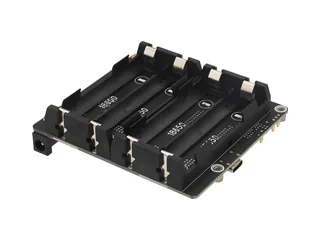
Geekworm X1202 — power and a battery for a Pi 5
The X1202 solves two Pi 5 problems at once: its 5.5 × 2.1 mm DC jack accepts 6–18 V, so it can run straight from a boat feed, and it carries four 18650 cells so the Pi has a battery to shut down on. Geekworm says it handles AC-loss detection, auto power-on and software power-off. Its page does not say whether shutdown signalling uses GPIO or I2C, so check the wiki before you buy. Cells are not included, and lithium cells in a sealed locker on a boat deserve some thought: use quality cells and keep it ventilated.
Strengths
- Takes 6–18 V directly, so no separate converter is needed
- Gives the Pi 5 a battery and a clean-shutdown route
- Designed for the Pi 5, with pogo-pin connection
Trade-offs
- Cells not included, and you carry lithium cells aboard
- Isolation, efficiency and operating temperature are not stated
- Shutdown signalling method not stated on the product page
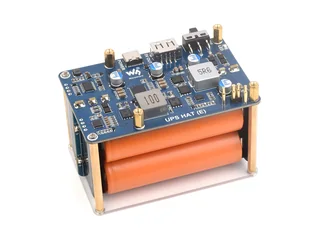
Waveshare UPS HAT (E) — cheaper, but needs USB-C PD in
Waveshare's UPS HAT (E) is a Pi 5-compatible HAT that holds four 21700 cells and outputs 5 V at up to 6 A, with battery status over I2C. Its input is USB-C power delivery only, so it does not take a 12 V boat feed directly: you would need a 12 V to PD converter in front of it. That makes it a good fit if you already have a PD source and a worse one on a bare boat feed. Cells are not included.
Strengths
- Lower price than the Geekworm
- Stronger 5 V/6 A output
- Status readable over I2C
Trade-offs
- USB-C PD input only, so it needs a converter in front on a boat
- Cells not included
- Not a drop-in 12 V solution
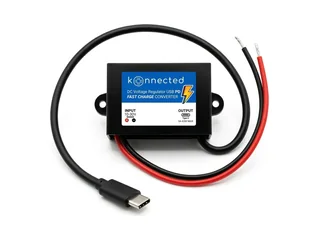
Konnected DC to USB-C PD converter — boat-rated, but short on current
Konnected's converter takes 10–30 V and says it suits car and boat systems, with overcurrent shutoff at 3.5 A and reverse-polarity protection. The catch for a Pi 5 is the output: up to 3.25 A, about 16 W at 5 V, not the 5 V/5 A Raspberry Pi recommends. Raspberry Pi's own whitepaper says that without a 5 A power-delivery offer, USB output is limited to 600 mA and USB boot is disabled, and Konnected itself says it may not cover the Pi 5's 27 W peak. It is fine for a light headless Pi and a poor choice for one with an NVMe drive and USB devices.
Strengths
- Accepts 10–30 V and states car and boat use
- Cheap, with reverse-polarity protection
- Small and simple
Trade-offs
- About 16 W at 5 V, not the 5 V/5 A Raspberry Pi recommends
- Heavier loads can brown out a Pi 5
- Isolation and efficiency not stated
Clean shutdown
Hard power cuts corrupt storage, and boats cut power often. On a Pi, boot from NVMe and add a UPS HAT so the board gets time to halt (our onboard computer guide covers the SD-card risk, citing Raspberry Pi's own whitepaper). Raspberry Pi's docs say a halted Pi 5 still draws about 1–1.4 W by default, and the POWER_OFF_ON_HALT bootloader setting can lower it, though its docs also warn it may cause problems with some HATs because 5 V can stay on.
For a mini PC we found no verified 12 V UPS from an established maker that signals shutdown. The honest answer is that a boat battery is already a UPS: the risk comes when the battery switch is turned off, so shut the computer down from the operating system first, and keep it on a circuit you can switch deliberately. A voltage-triggered shutdown is a real design, but we don't have a sourced, tested version to recommend.
Fusing and wiring
The rule most boats get wrong is where the fuse goes. Blue Sea's explanation of ABYC E-11 says each ungrounded conductor connected to a battery or charging source needs overcurrent protection within 7 inches (175 mm) of the connection point, extended to 40 inches if the conductor is sheathed or in conduit and 72 inches if it connects directly to the battery terminal and is sheathed. A fuse protects the wire, not the load: size it for the wire's ampacity. Blue Sea advises running wire at no more than 80% of its rated ampacity, notes most fuses trip at about 130% of rating, and warns that its own table values may be dated, so check the current standard.
For a computer feed, that means a fuse or a fused block close to the battery, then wire sized for the run and the converter's maximum input (about 10.5 A for the Victron at full load, far less at a real 20 W load), then the converter near the computer. Blue Sea's ST Blade fuse blocks are rated 100 A per block and 30 A per circuit at 32 V DC maximum according to its listing, which suits a small DC panel. Use marine tinned copper wire and proper crimped terminals, and keep everything dry.
Shopping list
All Amazon links go to searches, so check the seller and the exact model on the listing.
Victron Orion-Tr 12/12-9 · Mean Well SD-100A-12 · Blue Sea ST Blade fuse block · Marine tinned copper wire · Heat-shrink ring terminals
Geekworm X1202 · Waveshare UPS HAT (E) · Konnected USB-C PD converter · Official 27 W supply · 18650 cells
Frequently asked questions
Do I need a DC-DC converter to run a mini PC from a boat battery?
We would use one. The mini PCs in our onboard computer guide list a 12 V adapter output but no stated DC input range, and a boat's bus runs from about 12 V up to roughly 14.8 V while charging. A regulated converter such as the Victron Orion-Tr 12/12-9 gives the computer a steady 12.2 V from an 8–17 V input. The other safe route is an inverter and the supplied AC adapter, which wastes more power.
Can I power a Raspberry Pi 5 from a 12 V boat battery?
Yes, but the options are limited. Raspberry Pi recommends 5 V/5 A, and we found no established-brand 12 V converter that states 5 A over USB-C. A UPS HAT with a wide DC input, such as the Geekworm X1202 at 6–18 V, powers the Pi directly and gives it a battery. A converter like Konnected's offers up to 3.25 A, which is reduced-USB mode on a Pi 5.
What fuse should I use for a boat computer?
Size the fuse for the wire, not the computer, and put it within 7 inches of the battery connection, or the longer ABYC distances for sheathed wire. A converter's maximum input current is your floor: the Victron draws about 10.5 A at full load from 12 V. A fused block such as Blue Sea's ST Blade (30 A per circuit) is common. Check the current ABYC E-11 text or ask a marine electrician.
Will a DC-DC converter protect my computer from voltage spikes?
The makers we checked don't say. Neither the Victron datasheet nor the Mean Well page we read states load-dump survivability, so don't assume it. Standard practice is to avoid opening the battery switch while the engine runs, and to run the computer from the house bank rather than the starting battery.
Should the computer run off the starting battery?
Normally no. Automotive test standards model cranking dips to 4.5 V for milliseconds, and the Victron shuts down at 7 V, so a computer on the starting battery can reboot when you crank. Run it from the house bank where you can.
Do I need a UPS for a boat mini PC?
We found no verified 12 V UPS from an established maker that signals shutdown to a mini PC. The battery is already a kind of UPS. The risk is switching the battery off, so shut the computer down from the operating system first.
The short version, by computer
Mini PC with a 12 V adapter: Victron Orion-Tr 12/12-9, or the cheaper Mean Well SD-100A-12 for a dry, indoor install, plus a fuse within 7 inches of the battery.
Raspberry Pi 5: Geekworm X1202 for a 6–18 V feed and a battery to shut down on. The Konnected converter only for a light Pi.
Either way: a fused block sized for the wire, the house bank rather than the starter battery, and a clean shutdown before you switch the battery off.