How GPS anchoring works
A GPS-anchoring trolling motor is a bow-mounted electric motor that steers itself. It has a GPS receiver and a heading sensor (an electronic compass), and when you press the anchor button it stores your position. From then on it measures how far wind and current have pushed you, and turns and runs the prop to bring you back. Minn Kota calls this Spot-Lock, Garmin calls it anchor lock, and Lowrance simply says anchor, but they all do the same job.
It replaces an anchor in water where you'd rather not drop one: over a reef or wreck you don't want to snag, in water too deep for a shallow-water anchor, or for the twenty minutes you want to sit on one spot while you fish, swim or wait for a bridge. It doesn't replace an anchor overnight. It only works while the motor has battery, and a 24 V bank can only hold you against a stiff wind for a few hours.
The same hardware does more than hold still. Every motor here can also hold a heading, record a path and replay it, and set a cruise speed. Minn Kota adds Jog, which moves your Spot-Lock five feet in any direction without re-anchoring, and Drift Mode, which holds speed and course together so you can drift a line without a drift sock. Garmin's Force Pro and Kraken use multi-band GPS, which picks up more satellite signals than single-band receivers and should hold tighter when the sky is partly blocked.
How tightly any motor holds depends on wind, current, the boat's windage and how much thrust it has in reserve. Treat the makers' accuracy claims as best case, and size the motor for the worst weather you plan to sit in.
Start with the chartplotter you already have
For a connected boat this is the deciding question, and most roundups bury it. Each brand's motor talks to its own family of fish finders and chartplotters, so the screen at your helm narrows the field before price or thrust do:
- Humminbird → Minn Kota. The two are sister brands (both Johnson Outdoors). Minn Kota's GPS motors are part of the One-Boat Network: from a compatible Humminbird you can drop a Spot-Lock on a waypoint, follow a depth contour or drive to a spot, and the One-Boat Network app on iOS and Android controls the motor, a Talon shallow-water anchor and the fish finder from your phone. Older i-Pilot and i-Pilot Link motors don't work with that app.
- Garmin → Force Pro or Kraken. Both connect wirelessly to Garmin chartplotters, so you can anchor or follow a route from the display. If you already run Garmin radar or the GPSMAP 8612xsv from our MFD guide, these are the natural fit.
- Lowrance → Ghost X. The Ghost X anchors, steers and sets speed from HDS PRO, HDS LIVE, HDS Carbon and Elite FS displays, and its foot pedal can raise and lower a Power-Pole anchor.
- Another brand, or no chartplotter at all. We couldn't confirm map-based control from Raymarine, Simrad or B&G displays for any motor here, so choose on the motor's own remote and app. Minn Kota's wireless remote has its own screen, and Haswing's Helmsman app shows a live map on your phone.
You can run a motor without its matching screen: every one here works from its own remote or foot pedal. You just lose map-based control from the helm, which is most of what makes these motors "connected".
Thrust, voltage and the battery bank
A common rule of thumb is about 2 lb of thrust for every 100 lb of fully loaded boat weight (people, fuel, gear), with more for windy water or tide. A 3,500 lb loaded bay boat therefore wants around 70 lb at the minimum, and more is better if you plan to hold position against current.
Thrust is tied to voltage, and voltage decides your batteries:
- 12 V (up to about 55 lb): one deep-cycle battery. Fine for small boats in sheltered water.
- 24 V (70–90 lb): two 12 V batteries in series.
- 36 V (100–115 lb): three in series. This is where every premium motor here is happiest.
Holding position is hard work for a battery: the motor runs constantly in short bursts all day. Lithium (LiFePO4) batteries suit trolling motors well, being lighter and holding their voltage as they discharge, and our lithium house bank guide covers the charging side. Whatever chemistry you use, a shunt-based battery monitor on the trolling bank tells you how much anchor time is left, which a voltage reading can't.
Brushless motors (Minn Kota QUEST, Garmin Force, Lowrance Ghost X) are more efficient than brushed ones, so the same battery bank lasts longer. That efficiency is most of what you're paying for in the $3,500–$4,300 bracket.
Shaft length: the spec people get wrong
Bow-mount motors are sold by shaft length, and each length is a separate product. Too short and the prop comes out of the water in a chop, the motor cavitates, and the GPS anchor can't hold. Too long and it drags in shallow water and is awkward to stow.
Measure from where the motor mounts on the bow down to the waterline, then use the maker's chart: Minn Kota, Garmin and Lowrance all publish one. As a rough guide, low bass boats suit 45–52 inch shafts, most bay boats and pontoons 54–60 inches, and deep-V and offshore boats with high bows 72 inches or more. That's why Garmin's Kraken comes in 48 to 110 inches and the Riptide Terrova QUEST goes to 100. If you fish rough water, go one size longer.
Several Amazon listings for these motors are for a single shaft length, so check the length in the title before you buy.
The motors, in detail
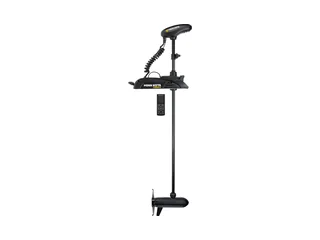
Minn Kota Terrova — the default for most boats
The brushed Terrova is the motor most people should look at first. It has Minn Kota's full GPS trolling system: Spot-Lock, Jog (the heading sensor that enables it is in the box), Drift Mode, recorded paths, and speed and steering control from a wireless remote with its own LCD screen. It's part of the One-Boat Network, so a compatible Humminbird can drive it from the map, and a stow/deploy lever on the mount lowers it into the water. Minn Kota currently lists the 80 lb, 60-inch model at $1,899.99 (down from $2,099.99), and the range starts at $1,649.99. The brushless QUEST version (below) adds more thrust per amp and costs about $1,500 more. For a family boat that anchors for an hour at a time, the brushed motor's lower efficiency rarely matters. On Amazon, Amazon itself sells the version with built-in MEGA Down Imaging sonar, with 80 or 112 lb and 45 or 60 inch shafts on the one listing, at $2,299.99–$2,399.99 when we checked; the no-sonar version and other shaft lengths are at Minn Kota and its dealers.
Strengths
- Full Spot-Lock system, Jog and Drift Mode at half the QUEST price
- Remote with its own screen; no phone or chartplotter needed
- One-Boat Network control from Humminbird and the phone app
- 12, 24 and 36 V versions, so it fits the battery bank you have
Trade-offs
- Brushed motor: less run time per charge than brushless rivals
- Freshwater only; salt water needs the Riptide version
- Map-based control is Humminbird-only
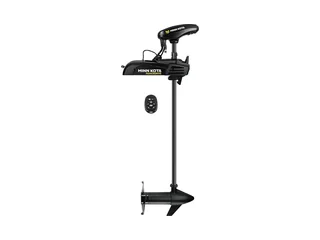
Minn Kota PowerDrive with GPS — Spot-Lock on a 12 V budget
The PowerDrive is the lighter, cheaper Minn Kota bow mount, and in its One-Boat Network versions it has the same GPS trolling system as the Terrova: Spot-Lock, speed and steering control, and the deploy-assist lever. At 45 or 55 lb on 12 V it runs from one battery, which suits small boats that don't have room or charging for a 24 V bank; the 70 lb version runs on 24 V. Minn Kota lists the PowerDrive range at $829.99 to $1,749.99, but the cheapest versions have no GPS, so make sure the model says GPS or One-Boat Network. The 55 lb GPS model was $1,176.99 on Amazon on 1 October 2026, but that listing is for a 54-inch shaft only, so we link to a search where you can pick your length.
Strengths
- Real Spot-Lock from one 12 V battery
- Much lighter and cheaper than the Terrova
- Same One-Boat Network integration with Humminbird
Trade-offs
- 45–55 lb won't hold a heavier boat in wind or current
- No-GPS versions look almost identical: check before buying
- Freshwater only (Riptide PowerDrive for salt)
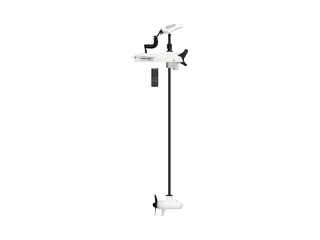
Minn Kota Riptide Terrova QUEST — for salt water and big bows
Salt water is where cheap trolling motors fail, and the Riptide line is Minn Kota's answer: the Terrova platform built for corrosion, with the brushless QUEST motor and shafts long enough for center consoles and high-bowed bay boats. It produces 90 lb at 24 V or 115 lb at 36 V, which is the thrust you want for holding on a reef or wreck against tide. It runs the full Spot-Lock system and joins the One-Boat Network with Humminbird. Minn Kota lists it from $3,999.99, rising to about $5,700 for the longest shafts. If you'd rather not lower and stow it by hand, the Riptide Instinct QUEST adds push-button stow and deploy, from $5,749.99. On Amazon this motor is mostly sold by third-party sellers with weak ratings, so we link to a search; buying from an authorized dealer protects your warranty.
Strengths
- Built for salt water, with the thrust to hold against tide
- Brushless efficiency: more anchor time per charge
- Shafts up to 100 in for high-bowed boats
Trade-offs
- About twice the price of a freshwater Terrova
- Needs a 24 or 36 V bank
- Manual stow unless you step up to the Instinct
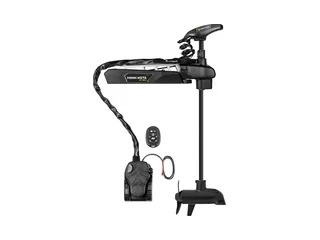
Minn Kota Terrova QUEST and Ultrex QUEST — brushless, for anglers who fish all day
QUEST is Minn Kota's brushless motor, and both of its premium freshwater bow mounts use it. The Terrova QUEST is the Terrova with the new motor: the same remote-driven Spot-Lock system, more thrust (90/115 lb) and longer run time, from about $3,500. The Ultrex QUEST is the tournament angler's version, cable-steered from a foot pedal for instant direction changes, in 45, 52 and 60 inch shafts, listed at $3,599.99 (down from $3,899.99) for the 45-inch model with Dual Spectrum CHIRP sonar. Both are freshwater motors with Humminbird integration. For a connected cruiser or family boat the brushed Terrova does the job for less, but if you fish all day on GPS anchor, the QUEST motor's efficiency is worth paying for. Amazon sellers for both are third parties with weak ratings, so we link to searches.
Strengths
- Brushless: more torque and run time than the brushed Terrova
- Ultrex's cable steering is the most responsive pedal here
- Deepest fish finder integration (Humminbird)
Trade-offs
- About $1,500 more than the brushed Terrova
- Ultrex's cable steering means a pedal on the bow deck
- Freshwater only
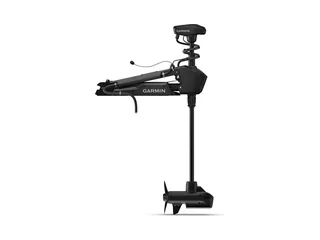
Garmin Force Pro — the pick for Garmin boats
Garmin launched the Force Pro in March 2025 as the successor to its original Force. Its headline feature is multi-band GPS for anchor lock, which Garmin calls its most precise boat positioning yet, plus reverse prop spin to stop overshooting the spot. The brushless motor makes 80 lb at 24 V or 100 lb at 36 V, the GT56UHD-TR transducer (CHIRP, ClearVü and SideVü) is built into the nose, and it comes with both a wireless foot pedal and a floating colour remote. Its real advantage is wireless control from a Garmin chartplotter: if your helm is Garmin, this is the motor that fits. Garmin lists it at $4,199.99 (50-inch) and $4,299.99 (57-inch). Garmin rates it for fresh, brackish and salt water, with a 3-year warranty and a limited lifetime warranty on the shaft. Those two shafts suit bass boats and low bows; deeper hulls need the Kraken. Amazon listings come from small third-party sellers, so we link to a search.
Strengths
- Multi-band GPS anchor lock and reverse prop spin
- Wireless integration with Garmin chartplotters
- Sonar transducer built in; pedal and remote both included
Trade-offs
- Among the most expensive motors here
- Only 50 and 57 in shafts
- Map control needs a Garmin display
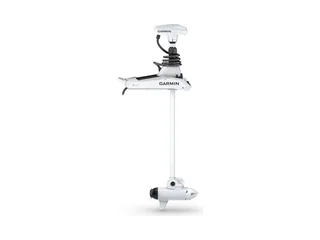
Garmin Force Kraken — Garmin's big-water and long-shaft motor
The Kraken is Garmin's motor for high-freeboard and saltwater boats: a 100 lb brushless motor on 24 or 36 V, a pivot-style mount that Garmin designed for bows with limited space, and the widest range of shafts here, from 48 inches up to 110 for tall center consoles. Garmin says it's engineered for harsh salt water, and it has the same multi-band GPS anchor lock and wireless Garmin chartplotter integration as the Force Pro; comes in white or black, and the GT56UHD-TR transducer is optional. Garmin lists it from $3,999.99 for the 48-inch model. It's the Garmin owner's answer to the Riptide Terrova QUEST. The Amazon listing we checked (sold by Prime Marine, a marine dealer) was for one shaft length only, so we link to a search where you can pick the right one.
Strengths
- Shafts to 110 in: fits boats nothing else here does
- Engineered for salt water, with multi-band GPS
- Garmin chartplotter integration
Trade-offs
- Map control needs a Garmin display
- Sonar is an add-on
- Long shafts are heavy to stow by hand
Lowrance Ghost X — the pick for Lowrance boats
The Ghost X replaces the original Ghost (97 lb at 24 V, 120 lb at 36 V), and Lowrance says it delivers 20% more thrust from a quieter brushless motor, on the same 24 or 36 V bank, with no battery or charger upgrade needed. You can anchor on a waypoint, your current position or anywhere on the map from an HDS PRO, HDS LIVE, HDS Carbon or Elite FS display, and steer and set speed from the screen. An optional GPS remote is available, and the foot pedal can also work a Power-Pole shallow-water anchor. It ships with the Active Imaging 3-in-1 nosecone (CHIRP, SideScan and DownScan) and lists NMEA 2000 connectivity. Lowrance lists the 47-inch model at $3,979.99; it's freshwater only. Amazon sellers we found had weak ratings, so we link to a search.
Strengths
- Full anchor and steering control from Lowrance displays
- Quiet brushless motor; 24 or 36 V on your existing bank
- Lifetime shaft warranty; foot pedal also runs Power-Pole
Trade-offs
- Freshwater only
- The GPS remote is an optional extra
- Map control needs a Lowrance display
Haswing Cayman B GPS — the cheapest with an app
Haswing is a Chinese electric-motor maker, and the Cayman B GPS is its bow-mount anchoring motor: GPS anchor (Haswing calls it spot lock), route record and replay, heading lock and cruise control on a 55 lb, 12 V motor. Unlike the Minn Kota PowerDrive, it has a phone app, Helmsman, which shows a live map and controls the motor from iOS or Android, and Haswing rates it for both fresh and salt water. It sells through Haswing's own Amazon store at $1,299.99, with 48 and 54-inch shafts on the same listing. What you give up is the track record, dealer network and chartplotter integration of the big three, so we'd treat it as a budget alternative to the PowerDrive rather than a replacement for the Terrova.
Strengths
- Phone app with a live map at a budget price
- Rated for salt water at 12 V
- Sold directly by the maker on Amazon
Trade-offs
- No chartplotter integration
- 55 lb is small-boat thrust
- Thin dealer and service network in the US
Fresh water vs salt water
Minn Kota, Garmin and Lowrance sell freshwater motors separately from saltwater ones, and the difference isn't marketing: saltwater models use corrosion-resistant materials and sealing that freshwater motors don't have. If you boat in salt or brackish water, buy a saltwater-rated motor: the Riptide Terrova QUEST or Riptide PowerDrive from Minn Kota, the Kraken or Force Pro from Garmin (Garmin rates the Force Pro for fresh, brackish and salt water), or the Haswing Cayman B GPS, which Haswing rates for both. Rinse any motor with fresh water after a day in salt, and check the warranty terms before using a freshwater model anywhere near the sea.
Install and wiring
A bow mount bolts to the front deck, usually on a quick-release plate so you can take the motor off for storage. Run heavy-gauge wire from the trolling battery bank to the bow, with a circuit breaker near the batteries sized to the maker's spec (Minn Kota sells its own, the MKR-27, for $54.99), and use a proper trolling-motor plug at the bow. Keep the trolling bank separate from the engine starting battery, and charge it with an onboard multi-bank charger or from your house system through a DC-DC charger.
On a connected boat, plan the network as well: the motor's Wi-Fi or Bluetooth link to the chartplotter, and Ethernet for Humminbird's i-Pilot Link. If you already run a NMEA 2000 backbone, check what the motor actually shares over it: the Ghost X lists NMEA 2000 connectivity, but map-based control on every motor here is designed around its own brand's displays.
Frequently asked questions
What is Spot-Lock on a trolling motor?
Spot-Lock is Minn Kota's name for GPS anchoring. The motor stores your GPS position and uses its prop and steering to hold you there against wind and current, with no anchor in the water. Garmin's version is called anchor lock and Lowrance's is simply anchor. All of them can also hold a heading, record and replay a path, and set a cruise speed.
How accurately does a GPS anchor trolling motor hold position?
Well enough to stay on a reef or a brush pile in moderate conditions, but it varies with wind, current, the boat's windage and how much thrust the motor has in reserve. Minn Kota's Jog moves your anchor point in 5 ft steps, which gives a sense of the precision involved. Garmin's Force Pro and Kraken use multi-band GPS for a tighter hold. Size the motor for the worst conditions you'll anchor in.
Do I need a trolling motor that matches my fish finder brand?
No, but you lose a lot without it. Every motor works from its own remote or foot pedal. Matching brands (Humminbird with Minn Kota, Garmin with Garmin, Lowrance with the Ghost X) lets you anchor on a waypoint, follow a contour or drive a route from the chartplotter, which is most of what makes these motors worth the money.
Should I get a 12 V, 24 V or 36 V trolling motor?
Match it to thrust and your boat. 12 V motors (one battery) top out around 55 lb and suit small boats in sheltered water. 24 V (two batteries) gives 70–90 lb, and 36 V (three batteries) gives 100–115 lb. The usual rule of thumb is about 2 lb of thrust per 100 lb of loaded boat weight, with more for wind and current. Holding position is hard on batteries, so lithium and a battery monitor are worth considering.
What shaft length do I need?
Measure from the mounting point on the bow down to the waterline, then use the maker's shaft chart. Low bass boats usually suit 45–52 in, bay boats and pontoons 54–60 in, and deep-V boats with high bows 72 in or more. Too short and the prop leaves the water in a chop and the anchor can't hold, so go longer if you fish rough water.
Can I use a freshwater trolling motor in salt water?
You shouldn't. Saltwater-rated models such as Minn Kota's Riptide line and Garmin's Kraken and Force Pro use corrosion-resistant materials that freshwater motors lack. In salt or brackish water, buy a saltwater-rated motor and rinse it with fresh water after each trip.
The short version, by boat
Most freshwater boats, especially with Humminbird: Minn Kota Terrova, from about $1,650. The full Spot-Lock system at half the brushless price.
Small boat, one 12 V battery: Minn Kota PowerDrive with GPS, about $1,200–$1,750, or the Haswing Cayman B GPS at $1,299.99 if you want a phone app or salt-water use.
Salt water: Minn Kota Riptide Terrova QUEST, from about $4,000, or the Garmin Force Kraken if your helm is Garmin.
Garmin helm: Garmin Force Pro, $4,199.99–$4,299.99. Lowrance helm: Lowrance Ghost X, $3,979.99.